
Why Safe Movement Can Still Feel Threatening: Creating Safety For Your Clients
One of my alumni came to me with a situation that I know so many movement professionals have seen before. Her client could perform the most beautiful bodyweight squat you’ve ever seen.
Great depth, great alignment, zero obvious compensation. SWOON.
But the second she added even a little bit of load, everything changed. Her jaw clenched, her breath stopped, her shoulders crept up toward her ears, and the entire movement went from smooth and confident to rigid and guarded.
When my alumni asked what she was feeling, the client said, “I don’t know. I just feel like something bad is going to happen.”
Here’s the thing: nothing bad was actually happening.

The load was light, the movement was well within her capacity, and her body had already demonstrated that it knew how to squat. But her nervous system made a different decision.
By that point, loading had become associated with danger. And once the nervous system decides something might be threatening, you can cue “relax your shoulders,” “breathe,” and “brace your core” all day long without changing the thing driving the protection.
This is where hyper vigilance can show up in movement, and I think we are seeing it in WAY more clients than we realize.
I think we all get it, don’t we? Personally, I get left ocular migraines, so there is a piece of me that is kind of always “on” because I don’t want anything to trigger one. If it happens, I’m either out for at least 20 minutes or pretending like there aren’t fireworks happening in my left eye while I temporarily can’t see properly. It creates this constant awareness of potential triggers and this little background feeling of, please don’t let that set one off. It ain’t fun!!
What Hyper Vigilance Actually Looks Like in Movement
Hypervigilance is essentially an increased state of scanning for potential threat. Your client may not consciously be thinking, Is this safe? Is this going to hurt? What if my back goes out again? What if I lose my balance? But their nervous system can still be asking those questions in the background and changing their movement accordingly.
For me, one of the worst triggers is being in the car when the reflection from the car in front of me suddenly shines directly into my eyes. I KNOW that can trigger a migraine, so I have to remainnnn calm and not immediately freak out, which is challenging! My nervous system has learned that particular sensory input might mean trouble, so it pays very close attention to it.

With your clients, that protective response might show up as jaw tension, breath holding, excessive muscle guarding, co-contraction, stiffness, slowed movement, avoidance, or an increase in pain.
The important distinction is that bracing itself is not bad. WHOA… read that again!
Intentional bracing is useful and necessary. The issue is when the amount of protection is excessive for the demand, appears before the movement is even challenging, or seems to stay “on” all the time.
A client may think they are simply concentrating harder or trying to be strong, when their system is actually operating in a low-grade state of alarm. Research around pain, threat perception, and hypervigilance suggests that constantly monitoring the body for danger can make uncomfortable sensations more salient and pain feel more intense. NO BUENO.
There is also a motor learning component a.k.a. your brain only has so many resources available at one time. If a big chunk of those resources is being used to scan for danger, monitor symptoms, and anticipate pain, there may be less capacity available for learning a new movement, processing your cues, coordinating the task, and adapting to load.
How to Spot It in Your Client
One of the easiest clues is to watch what happens before the movement actually gets difficult. You add five pounds and they immediately stop breathing. You ask them to bend forward and their jaw tightens before they move. You mention testing the painful shoulder and their entire upper body stiffens before you touch them.

My favorite is when I tell someone I’m going to demonstrate the movement first, and I simply watch their response. Sometimes I can tell it is a no-go before they even attempt the exercise, just by watching their face and body as they watch ME do it.
That gives you information, and information/data is GOOD.
Language matters too. Listen for phrases like, “I don’t trust my body,” “I’m scared it’s going to hurt again,” “I feel unstable even though I know I’m not,” or “I feel like something bad is going to happen.” Your client is telling you how their brain is interpreting the experience.
This is exactly why I want movement professionals to look beyond biomechanics. Joint angles, strength and mobility matter! But perception matters too. Their upbringing, culture, previous pain experiences, pain education, beliefs, and expectations can all influence the way their nervous system responds, even when it doesn’t necessarily make sense to US.
So What Do You Actually Do?
First, recognize that you may not be dealing with a form problem. We movement professionals are trained to look for things to correct, so we see tension and immediately start troubleshooting mechanics. We change foot position, cue the glutes, adjust the rib cage, mobilize the ankle, relax the traps, or tell them to breathe. WE ALL DO THIS haha, and it isn’t bad or wrong.
But if the nervous system has already decided that the movement is threatening, perfecting the mechanics may not be the first domino.
Sometimes you need to change the information the nervous system is receiving.
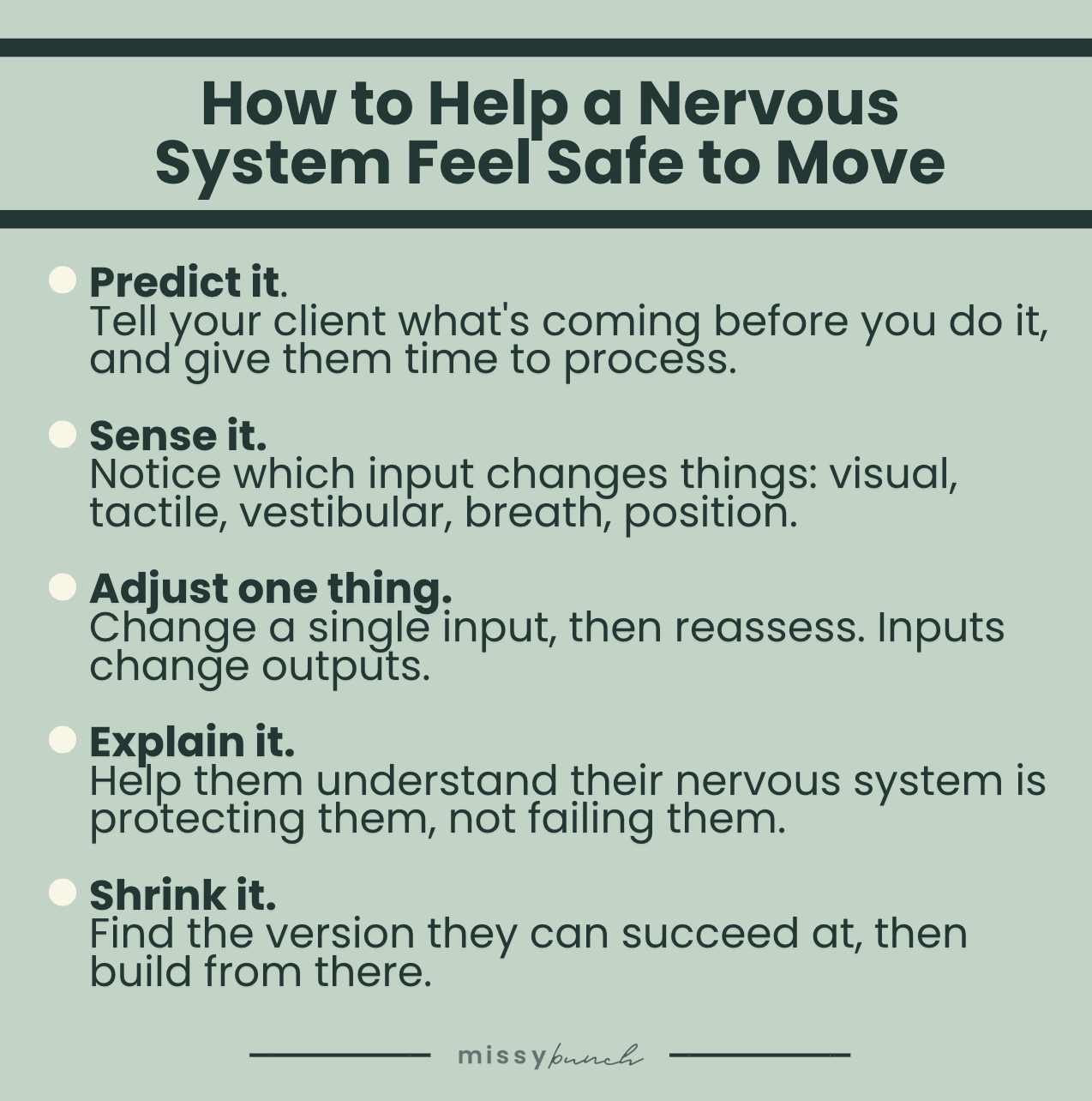
Start with predictability. Tell your client what you are going to do before you do it. Let them watch the movement. Explain when you are adding load and give them enough time to process what is happening. A nervous system that is already scanning for danger generally likes to know what is coming next.
Then look at the sensory input. This is obviously where I get nerdy. The brain is constantly integrating visual, vestibular, proprioceptive, tactile, interoceptive, and even olfactory information to decide what is happening and how it should respond.
Maybe your client does better with a stable visual target. Maybe watching themselves move changes something. Maybe tactile input helps. Maybe you change their breathing, head position, stance, speed, or even use smell or a simple visual exercise first.
Inputs change outputs. (you’ve never heard me say this right?? LOL)
The important part is that you are not randomly throwing nervous system exercises at somebody. Change one input, then reassess the movement and see if the output actually changes.
Education can also be incredibly powerful. One of my alumni explained this concept to a client, and the client said, “I thought I was just mentally weak. Knowing my nervous system is trying to protect me changes things.”
That does not mean the pain is imaginary, and it definitely does not mean telling someone, “You’re fine, just move.” It means helping them understand that their nervous system is making predictions based on previous experiences, current sensory information, context, and perceived threat.
Finally, make the task small enough that they can succeed. Can they tolerate the starting position? Can they do 25 percent of the movement? Can they perform it without load? Can they simply hold the load without moving? Find the entry point where the nervous system says, Okay, I can handle this, and build from there.
How This Looks In Practice
One thing I’m always going to do, is try to get y’all to look beyond the painful body part. Because, your client might spend months strengthening, stretching, mobilizing, foam rolling, and buying seventeen resistance bands on Amazon for their shoulder, yet the shoulder is still tight.
Then BOOM, you realize the shoulder tension may be part of a much bigger protection strategy.
They are anticipating pain before the movement even begins, so their breathing changes, their jaw tightens, their posture changes, and their entire motor strategy shifts. When you address that bigger picture, movement can change without needing some magical corrective exercise.
The goal is not to force your client to relax or convince them that nothing is wrong. The goal is to give their nervous system better information, create successful movement experiences, reassess what changes, and gradually build capacity.
Sometimes the body simply needs enough evidence to decide, Oh. Maybe I don’t need THAT much protection here.
Not Sure Where to Start With a Client Like This?
If you’re reading this thinking, “Okay Missy, I see the guarding, but how the heck do I know what to assess first?” I made something specifically for you.
My free Where Do I Start? A Neuro Starting Point Cheat Sheet for Movement Pros walks you through five simple places to begin when a client’s pain, movement, or nervous system response is making you scratch your head. Instead of testing 47 things and hoping something sticks, you can start with a few high-value observations, choose one input, and reassess whether it actually changed anything.
Because the goal is not to know every neurological assessment on earth. The goal is to know where to start.
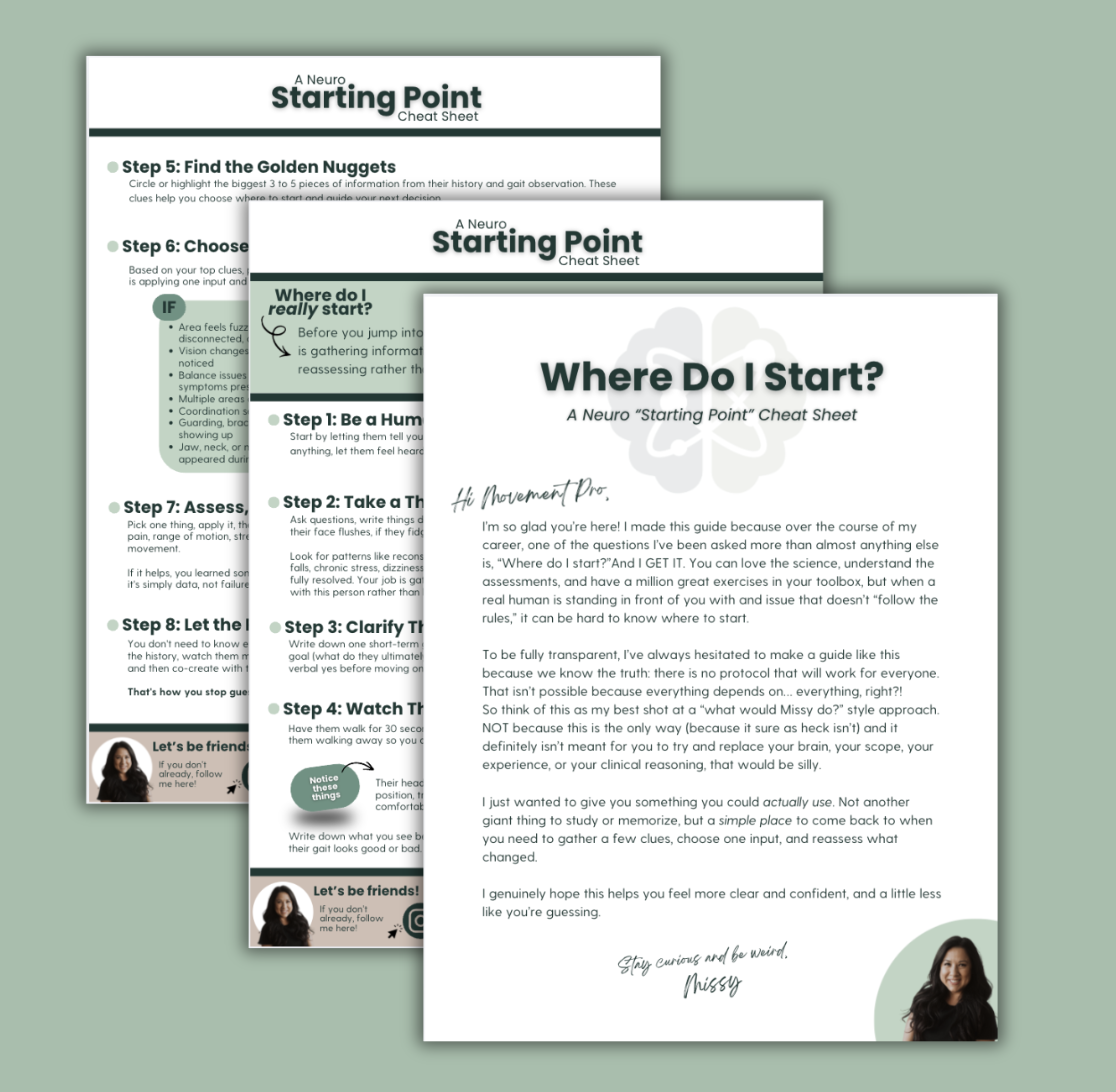
Grab the free cheat sheet here
I love you, you got this!
Missy 💙
P.S. This week, notice which movements make your client start protecting themselves before the movement even gets hard. Watch their jaw, breathing, shoulders, hands, feet, blink rate and facial expression, then ask yourself: What is their nervous system predicting right now?
Instead of immediately correcting the protection pattern, see what you can change about the load, sensory input, environment, or progression and then RETEST. You might be amazed by what changes and mostly how profound, can also be SUBTLE ;)