
Is Balance an Ankle Problem? Here’s How Vision Quietly Runs Postural Control
Movement pros, I am not here to disrespect the foot and ankle because I love them dearly and if you know ME, you KNOW that haha, but if your client looks wobbly and your first move is to go hunting for a weak tibialis posterior or an underactive intrinsic woozy whatsit… you are probably missing the bigger conversation. Postural control is a brain-led skill that is constantly being negotiated through sensory input, and vision has a habit of quietly becoming the dominant "organizing system" for balance. When you start screening vision on purpose, a lot of those stubborn balance cases stop feeling mysterious and start feeling like a solvable puzzle.
Vision is doing more than "seeing"

If vision is the DOMINANT sensory system shouldn't we be "dominantly" assessing it? As in, heavily assessing it? The eyes are not just part of the brain, THEY ARE BRAIN. They are an actual extension of the brain. So I will continue to say this as I have for the last 16 years, you MUST be competent in assessing the visual system. Then comes the vestibular system and so forth. I can't stress it enough.
In practical terms, vision gives the brain a live update on where the body is in space, how the environment is moving, and how much correction is needed to stay upright without face-planting, and that constant stream of information changes how much sway we allow and what strategy we choose. Research on visual conditions and postural control consistently shows that changing the visual environment can change stability and sway.
What "visual dependence" looks like in real clients
Most of the time, your client is not going to tell you "I rely on vision for balance," are they? Just like you wouldn't tell your doctor you think you have a shallow carotid artery or you're low on progesterone (well knowing some of you, you actually might do this because you are wicked smart and intuitive HAHA). Your clients are going to show you how off their balance is and how messed up their visual system is just by purely existing, and it usually looks like a huge drop in steadiness when the visual signal is reduced or taken away completely.
You see the movement strategy, the big sway, the rigid bracing, the breath holding, the jaw clench, and that immediate eye pop open like their brain just said "nope, we're done here," which are all data about how the nervous system is sourcing safety. Classic work on postural sway even highlighted the usefulness of comparing eyes open and eyes closed as a simple way to communicate an individual's reliance on vision for balance.
A simple way to screen it without turning your session into a science fair
If you want a clean, clinic-friendly way to stop guessing, run one balance stance with eyes open (for example feet together, lengthen up), then run the same stance with eyes closed, very simple but for most of your clients this simple test will not be as easy as it should be. Watch what changes in their body, their strategy, tone, and confidence. You are not looking for statue-still perfection (that doesn't exist), you are watching whether the nervous system can reorganize and whether it can tolerate the sensory shift without panic.
Once you see a big shift with eyes closed, the next move is usually not to make the balance exercise harder, because a harder exercise often just drives a stronger protective strategy AKA MORE THREAT. No joke, after my sister's brain surgery she told me they would have her stand on a balance ball (the half flat half blue ball ones) and they would throw a medicine ball at her to "improve her balance." I wanted to scream and cry and shake them. A person who just had brain surgery…REALLY? You think THAT is a good idea? To throw a heavy ball at them? Mind you, bringing a cup of water to her mouth is hard enough for her, let alone an unstable surface with an object coming towards you. My jaw and neck hurt just writing this out to you. Of course for SOME patients maybe that would be appropriate (I doubt it) but it surely wasn't appropriate for her. She could barely take 3 steps without losing her balance. Okay okay I digress…can you tell this gets me heated LOL
What tends to work better is meeting the client exactly where they are that day, not where your program says they should be. That might mean widening the stance, adding a stable external reference, or just changing the environment so the brain can stop acting like it is negotiating for its life. You are not lowering the bar, you are being smart about it.
Two quick visual screens that are worth your time
If you want to go one step deeper without overcomplicating, start with near-far focus for ten smooth reps and notice whether their tone shifts, their breath changes, or their head starts trying to "help" the eyes, then re-test the same balance stance immediately. Then, if it fits the person in front of you, layer in a smooth pursuit exercise where they track a slow moving target with just their eyes while you watch for choppy eye movements, more sway, tension creeping in, or the neck and jaw deciding to get involved when they absolutely were not invited LOL. A study on smooth pursuit exercises during one-leg standing found significant changes in center of pressure measures and muscle activity, which honestly just confirms what we see in the room every single day. The eyes are busy and balance pays the price when they are working hard.
➡️ For a FREE resource on how to do these 2 exercises, go here.
The coaching translation your clients will actually understand
If you want to keep this client-friendly, you can literally say, "I want to see how your balance changes when your eyes can't help," and then run the screen, spot them (of course please be ready for a fall if needed), and treat whatever happens as useful information rather than a pass or fail. It isn't "bad" to have a poor reassessment, it is DATA. It is INFORMATION. That is it! Your clients do not need cranial nerve jargon, honestly that is the last thing they need haha. They just need you to talk to them like a normal human being, make them feel safe, and show them you know what you are looking at. That is it.
The takeaway
Listen, the ankle is great. I LOVE the ankle. The ankle has never done anything wrong to me personally LOL. But if your client is wobbling all over the place and your first instinct is to go digging around in their foot, we need to talk. Like in the way when you're in trouble at the principal's office. Haha just kidding I kid I kid!!
I have been saying this for 16 years and I will say it for 16 more, stop starting at the ankle when the brain is running the whole show. Vision is not a footnote, it is the headline. And this is THE thing that keeps me up at night (well, that AND my 3.5 month old, let's be honest) it is that we have an entire sensory system practically SCREAMING at us to be assessed first and we are down there rubbin' ankles. Not on my watch!
So to wrap this all up in a pretty little bow that your nervous system will actually appreciate, vision is not a bonus assessment, it is THE assessment. Start there. When you stop assuming balance lives in the ankle and start treating vision as a primary organizer of posture, you get cleaner starting points, faster wins, and fewer sessions where you are throwing random balance exercises at a nervous system that is just trying to feel safe.
And honestly? This is one of those things that once you SEE it (pun absolutely intended hehe), you literally cannot unsee it. You will be at the grocery store watching someone wobble reaching for the top shelf and think "hmm, I wonder what their eyes are doing." You will be watching your kid (or someone else's kid) trip over literally nothing and go "INTERESTING." It rewires how you observe humans moving through space and I think that is one of the coolest things about this work. #sorrynotsorry
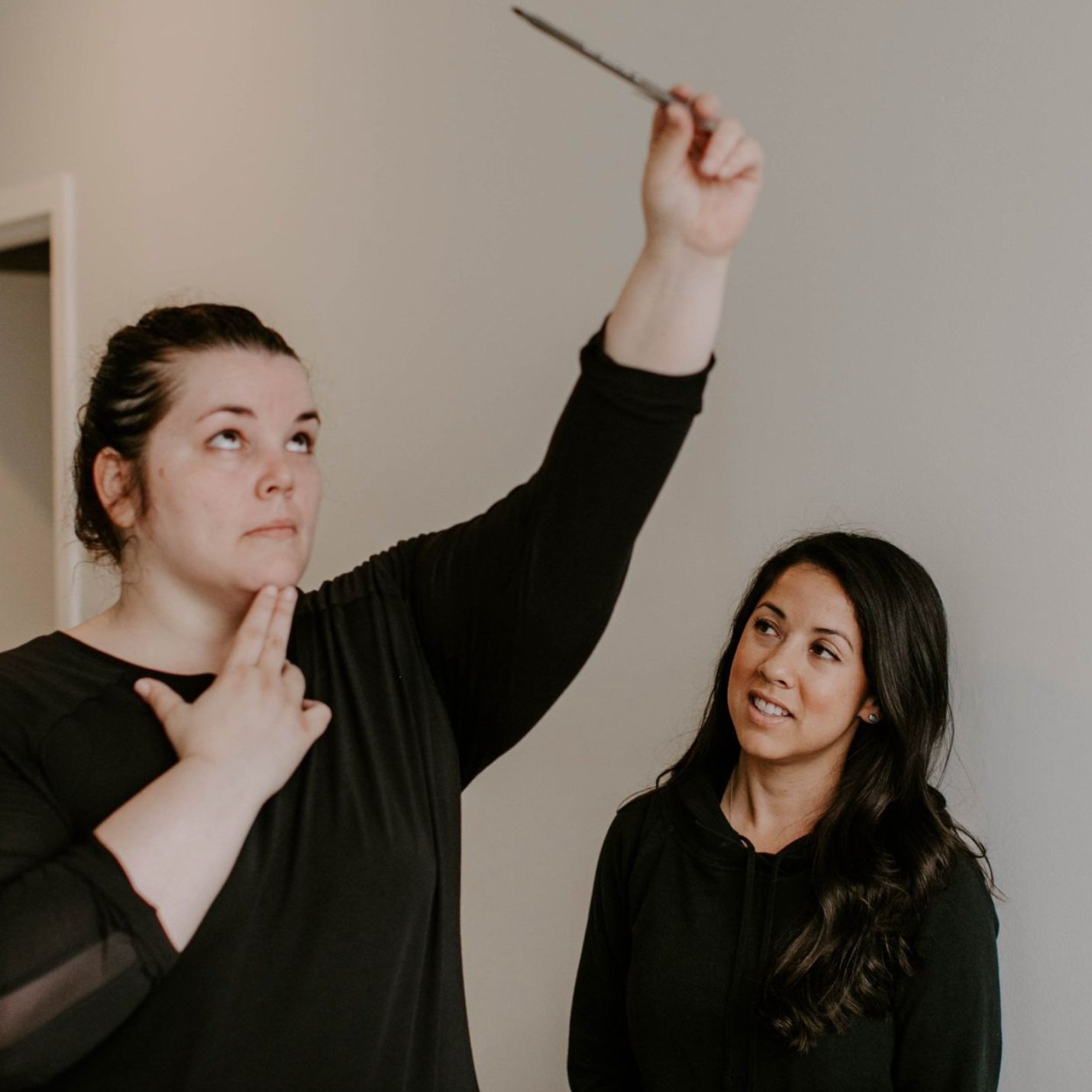
The nervous system does not care about your exercise progressions or your beautifully color-coded program. It cares about ONE thing. AM I SAFE? And vision is one of the loudest systems answering that question. So when we ignore it in our assessments, we are essentially showing up to a conversation and only listening to half the room. You would never do that with a client (because you are TOO smart and TOO thorough for that, and also you are reading this blog so clearly you are the type of person who actually CARES, hi I see you), so why are we doing it with their sensory systems?
Start small. Eyes open, eyes closed. Watch what happens. Let THAT be your data. You do not need a fancy lab or a $10,000 vibrating force plate to notice that someone's entire nervous system just went into threat mode the second their visual anchor disappeared (closing their eyes), you just need to know what to look for and actually LOOK FOR IT on purpose.
Because at the end of the day, the goal is not to give your client harder exercises. The goal is to give their nervous system a reason to feel safe enough to move better.
And sometimes (honestly, a lot of the time) that starts with the eyes.
Okay I could talk about this forever so I will shut up now and let you go. Go assess some eyes. Change some human beings. Report back. You've got this. 👁️
See you next month!!
Don't forget to download this free guide: "How To Improve Your Client's Vision"